
Rudra Ji
Studies

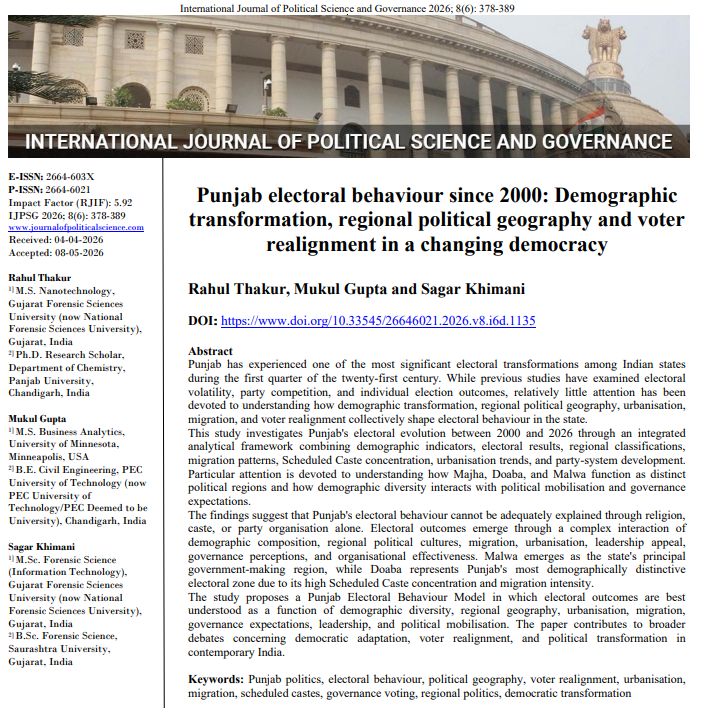
Punjab electoral behaviour since 2000: Demographic transformation, regional political geography and voter realignment in a changing democracy
What it’s about
The paper looks at why Punjab’s voters have changed their political choices so much between 2000 and 2026 — going from Congress, to the Akali Dal-BJP alliance, to the sudden rise of AAP. The authors argue that no single factor (religion, caste, or party organization) explains this. Instead, it’s a mix of many things working together.
Main argument
Old-school thinking says: people vote based on their religion or caste. Punjab breaks that rule. The paper shows that districts with similar caste or religious makeup often vote completely differently — so something else must be driving the choices.
Their proposed formula, in plain terms:
How Punjab votes = demographics + which region they’re in + how urban/rural + migration background + how good the leader seems + how well the government performed + anti-incumbency mood
Key findings
1. Punjab has three-and-a-half “political worlds,” not one state:
– Majha (border areas like Amritsar) — driven by religious/Sikh identity and security concerns
– Doaba (Jalandhar, Hoshiarpur) — has the highest population of people with family working abroad (huge NRI/migrant influence), highest Dalit (Scheduled Caste) population, and voters here are more focused on governance because of exposure to how things work abroad
– Malwa (the biggest region — Ludhiana, Patiala, Bathinda, etc.) — whoever wins here basically wins the state; it’s the “kingmaker” region
– Urban Punjab (cities) — an emerging 4th category where voters care most about roads, services, and administration, and switch parties easily
2. Caste doesn’t vote as a block. Even though Punjab has India’s highest Dalit population (~32%), Dalit communities themselves are very diverse (Ravidassia, Ad-Dharmi, Mazhabi Sikh, Valmiki, etc.) with different histories and loyalties — so they don’t vote uniformly.
3. Migration matters a lot, especially in Doaba. Families with relatives abroad get exposed to how “better run” countries function, which raises their expectations of government back home — leading to more governance-focused (rather than loyalty-based) voting.
4. Urbanization is fragmenting politics. City voters don’t stick to one party — they judge based on issues like traffic, water, and services, leading to closer, less predictable races.
5. AAP’s rise was the big story. Unlike old parties that relied on caste or religious vote banks, AAP built support across all regions and appealed to voters unhappy with governance — proving Punjab has shifted from “identity voting” to “performance voting.”
6. Anti-incumbency is huge. Table 6 in the paper ranks anti-incumbency as the single strongest factor — Punjab voters seem to punish whichever party is in power almost every election, more than any other factor.
Bottom line
Punjab isn’t just voting based on “who’s Sikh, who’s Hindu, who’s Dalit.” It’s become a place where people vote more like customers judging service quality — based on whether the government delivered good roads, jobs, healthcare, and education — while regional identity (Majha vs. Doaba vs. Malwa) still shapes how that judgment plays out.
One caveat from the authors themselves: the study is mostly built from data (election results, census numbers) rather than interviews or surveys, so it doesn’t fully capture the human, cultural side of why people vote the way they do — that’s flagged as something for future research.
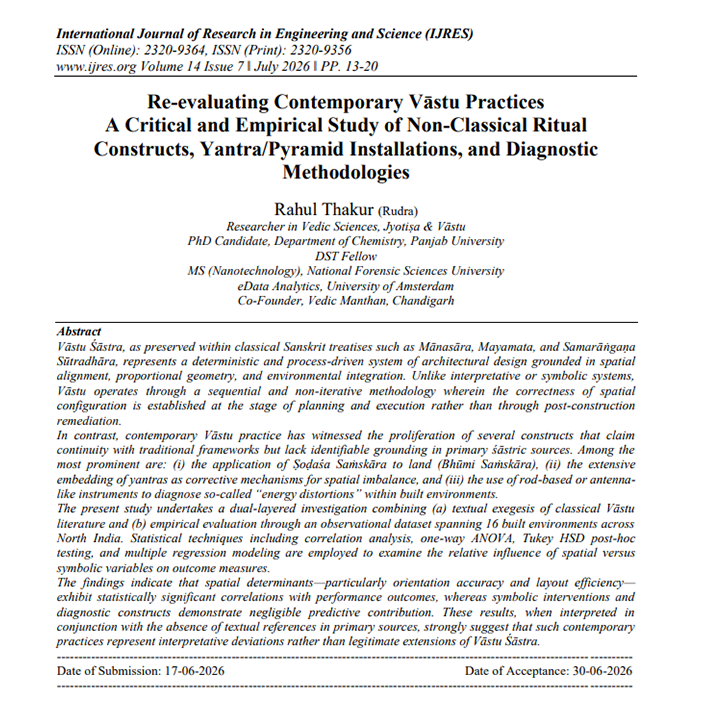
Re-evaluating Contemporary Vāstu Practices A Critical and Empirical Study of Non-Classical Ritual Constructs, Yantra/Pyramid Installations, and Diagnostic Methodologies
What it’s about
This paper looks at modern Vastu (Vedic architecture/feng-shui-like practice) and asks: are today’s popular “fixes” — like burying multiple yantras (mystical diagrams) around a property, taping symbols on floors, or using dowsing rods/antennas to detect “bad energy” — actually part of the real, ancient tradition? Or have they been added later without real backing?
The core argument
Classical Vastu (from old Sanskrit texts like Mānasāra and Mayamata) was designed to get things *right from the start* — through site selection, purification, and correct measurements before construction. It was never meant to be something you “fix” after the building is already up.
But modern practitioners often treat Vastu like a problem-solving service: if something feels off, you add a yantra, tape a symbol, or wave a rod to “diagnose” bad energy. The authors argue this is a relatively recent commercial invention, not something rooted in the old texts.
What they checked
1. Do the old texts support these modern remedies?
→ No. The researchers went through the classical sources and found no mention of things like applying “16 life-sacraments” (normally used for people, e.g., naming ceremonies, marriage) to land, no mention of burying multiple yantras, and no mention of rod/antenna-based energy detection. They call these a “category error” — like using a ritual meant for humans and applying it to dirt.
2. Do these modern practices actually work, statistically?
→ They studied 16 real buildings across Punjab, Haryana, and Delhi — split into three groups: buildings following classical Vastu principles, buildings using modern remedial tricks (yantras, rods, etc.), and buildings with no Vastu at all (control group). Each site was scored on real-world outcomes (how well the space functioned, occupant satisfaction, financial/operational stability, comfort).
What they found
– Classical Vastu buildings scored highest (average 8.34/10)
– Modern “remedy” buildings scored about the same as buildings with no Vastu at all (6.17 vs. 6.22) — meaning the yantras and rods made essentially zero difference
– Statistically, things like correct orientation, efficient layout, and proper timing (Panchāṅga) were strongly linked to better outcomes
– Things like yantra placement and rod diagnostics showed almost no correlation with better outcomes (basically noise)
– A regression model confirmed: 78% of the outcome differences could be explained by the real, spatial factors — not the symbolic ones
Their explanation for why rods “seem” to work
They point to something called the *ideomotor effect* — a well-documented psychological phenomenon where a person’s own unconscious muscle movements (driven by expectation/belief) make a hand-held rod move, creating an illusion that it’s detecting something external, when it’s really just the person’s own body.
Bottom line
The paper’s conclusion is essentially: *real Vastu is about getting the architecture right in the first place* — orientation, layout, proportions. The popular add-ons you often see today (multiple yantras, taping rituals, energy-detecting rods) aren’t backed by the old texts and don’t show any measurable benefit in their data. The authors see this as “ritual inflation” — a drift from a rigorous design science into more of a belief-based, commercialized practice — and argue practitioners should refocus on getting the design right upfront rather than selling after-the-fact fixes.
(Caveat worth flagging: the study sample is very small — just 16 buildings — and the outcome scoring involved some subjective judgment, which the authors themselves acknowledge as a limitation.)
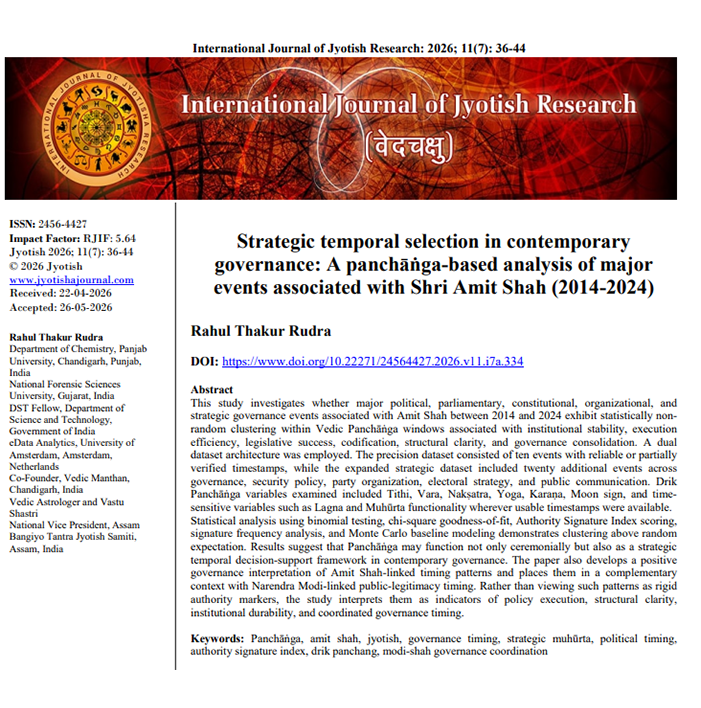
Strategic temporal selection in contemporary governance: A panchāṅga-based analysis of major events associated with Shri Amit Shah (2014-2024)
What it’s about
This paper (by the same author as the Vastu paper) argues that major political events in Amit Shah’s career (2014–2024) — his oath as Home Minister, the Article 370 decision, the Citizenship Amendment Act, his BJP presidency, election victory speeches, etc. — weren’t just randomly timed. The author claims these events cluster around astrologically “favorable” moments according to the Vedic Panchāṅga (a traditional Hindu almanac system that rates the qualities of specific date/time windows).
The core idea
The Panchāṅga has five components (lunar day, weekday, lunar mansion, sun-moon angle, and a half-day unit) that traditionally describe what kind of energy a moment carries — good for starting things, good for finishing things, good for stability, etc. The author’s argument: rather than there being one single “auspicious time” for everything, *different types of actions need different types of favorable timing* — a legal bill needs “codification” energy, an oath of office needs “stability” energy, a party appointment needs “network-building” energy, and so on.
What they did
– They compiled 10 well-documented events (like the Article 370 announcement, CAA passage, Shah’s oath, etc.) with known dates/times, plus 20 more loosely-timed events
– For each, they looked up the Panchāṅga values for that exact moment and rated how well the astrological qualities matched the “type” of action being taken (e.g., does a legal bill’s timing show “completion/boundary-defining” astrological signatures?)
– They ran basic statistics (a coin-flip-style test, a chi-square test, and a simulation) to see if this matching happened more than you’d expect by pure chance
What they found
– 8 out of 10 major events fell into “favorable” or “highly favorable” astrological timing categories (80%)
– Their statistical tests came out borderline significant (p ≈ 0.05–0.057) — meaning: interesting, but right on the edge of what statisticians consider “unlikely to be chance”
– A simulated random comparison showed the real events scored almost double what you’d expect if timing were random
– Big set-piece events like the Article 370 process specifically lined up with “administrative execution and completion” astrological signatures, while the CAA process lined up with “boundary-defining/legal codification” signatures — supporting their idea that timing was matched to purpose, not just generically “lucky”
Extra angle
The paper compares this to a related study the same author apparently wrote on Narendra Modi’s event timings, and proposes that Modi’s events lean toward “public legitimacy and renewal” timing, while Shah’s lean toward “execution and institutional delivery” timing — framing the two as a complementary pair.
Bottom line
This is a speculative, astrology-based interpretive study, not a mainstream political science paper. The author openly acknowledges major limitations: the sample is small (10–30 events), several event timestamps are approximate rather than exact, the “favorable vs. not” scoring involves the author’s own subjective judgment calls, and the statistical results only reach borderline significance. The author frames it as “exploratory evidence” for the idea that ancient time-selection principles might function as a real decision-support system in modern governance — but this is very much a proposed framework/hypothesis rather than an established, peer-verified finding, and it rests on the assumption that Panchāṅga timing has a genuine relationship to real-world outcomes, which the paper doesn’t independently establish.
Moon-mercury configuration and parent-reported behavioral patterns in children
What it’s about
This paper (again by the same author) asks: do kids who have a specific astrological placement — the Moon and Mercury being connected in their birth chart (either in the same zodiac sign, or in a “mutual exchange” relationship) — show different behavior patterns than kids without that placement? In classical Vedic astrology, the Moon represents mind/emotions and Mercury represents intellect/learning, so this combo is traditionally thought to affect a child’s mental/emotional makeup.
What they did
– Looked at 48 children total: 24 with the Moon-Mercury connection (“Group A”) and 24 without it (“Group B”, the control group)
– Parents rated their kids on three things: attention needs, difficulty in handling, and mood swings
– Compared the two groups statistically
What they found
Kids in Group A (with the astrological connection) scored noticeably higher than Group B on all three measures:
– Attention needs: 4.68 vs 3.21
– Difficulty in handling: 4.32 vs 2.98
– Mood swings: 4.14 vs 3.02
All three differences were large and statistically significant (very low p-values, meaning unlikely due to random chance) — the kind of effect size researchers would call “big,” not subtle.
Important honesty flags — this paper is unusually self-critical
This is worth calling out because the author is remarkably upfront about the study’s weaknesses, more than most papers:
– No info on how kids were recruited, their ages, gender split, or family background — meaning we don’t know if the two groups were even comparable to begin with
– No validated psychological test was used — just informal parent questionnaires/interviews, with no proof they’re reliable or standardized
– No blinding — the people rating the kids’ behavior likely knew which astrological group the child was in, which opens the door to unconscious bias (parents/interviewers subtly rating kids differently based on expectation)
– The astrological calculation method itself is undocumented — which zodiac system, which software, how “same sign” was verified, etc.
– Two of the five originally planned outcomes (emotional stability, learning ability) had to be dropped because the data wasn’t preserved
– Extra correlation numbers from an earlier version of the manuscript are flagged as unverifiable — the author explicitly says these shouldn’t be trusted yet
– The author states plainly: this shows an “association,” not “causation” — something else (like reporting bias, or how the astrologer/researcher classified charts) could easily explain the pattern instead of the planets themselves
Bottom line
The numbers themselves show a real difference between the two groups of kids — but the study design is too weak (small sample, no blinding, no validated tools, no info on how groups were chosen) to say that a planetary configuration causes behavioral differences. The author frames this correctly as *hypothesis-generating, not proof* — essentially saying “here’s a pattern worth studying further with a properly controlled, blinded, and pre-registered study,” not “astrology predicts child behavior.” That’s a responsible way to present speculative findings, and the paper leans on established methods (Welch’s t-test, effect sizes, confidence intervals) rather than overselling the result — but the underlying data collection has enough undocumented gaps that the result shouldn’t be taken as solid evidence on its own.